How does a commercial steam system work?
A steam system has three stages: generation, distribution, and recovery. Treated feedwater is heated in the boiler to make steam; the steam travels through headers and control valves to heat exchangers and process equipment; and steam traps pass the condensed water (condensate) back to a receiver and deaerator for reuse. Upstream water treatment — a softener or reverse osmosis plus a deaerator — protects the boiler itself. Related reading: Boiler Operation: Boiler Zero to Boiler Hero
Why is steam such a common way to move heat?
Steam carries roughly 1,000 BTU per pound and moves itself through piping — pressure differences drive the flow, no pumps required. Temperature at the point of use is easy to control by controlling pressure, and the technology is mature and reliable. It's also why the boiler is usually the largest natural gas consumer in a plant, and why steam-system improvements can be worth six figures a year in larger facilities.
What is boiler horsepower (BHP)?
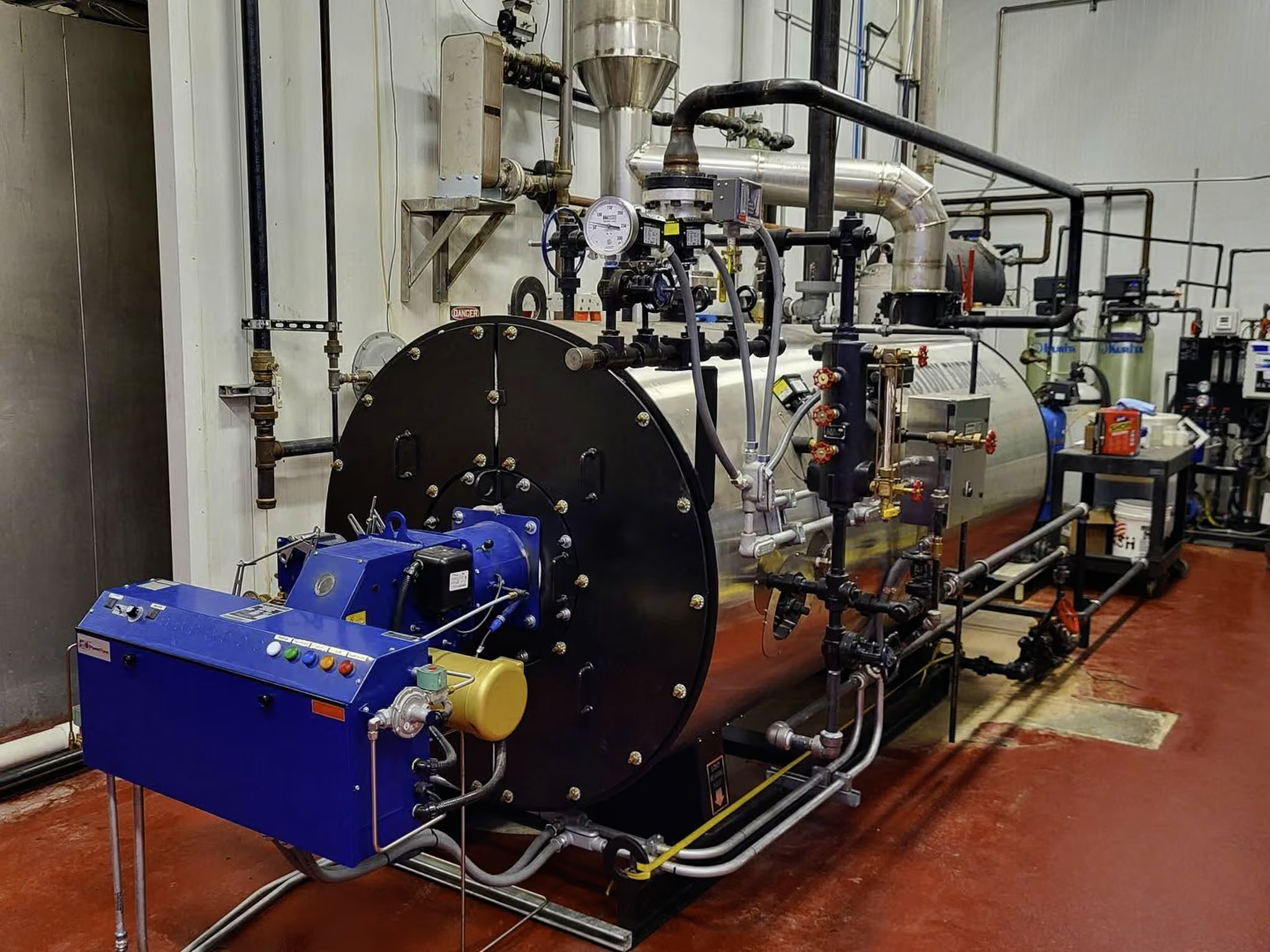
One boiler horsepower equals 34.5 pounds of steam per hour (from and at 212°F). Firetube boilers are rated in BHP — the largest scotch marine units run to roughly 2,200 BHP — while industrial watertube boilers are rated directly in pounds of steam per hour (PPH).
 What is the difference between a firetube and a watertube boiler?
In a firetube boiler, hot combustion gases pass through tubes surrounded by water; in a watertube boiler, water circulates inside the tubes with the fire around them. Scotch marine firetube boilers typically serve steam applications up to about 200 psig, hold a large water volume, and are easy to retube. Industrial watertube boilers run roughly 40,000 to 250,000+ PPH at 250 psig or higher design pressure, require cleaner feedwater, and are almost always paired with a feedwater economizer (~83–85% efficiency). Related reading: Watertube vs Firetube Boilers · Watertube Boiler: A Complete Overview
What are the common types of commercial boilers?
Beyond scotch marine firetube and industrial watertube ("D," "A," and "O" configurations), common types include firebox (locomotive) boilers for low-pressure steam and hot water, vertical tubeless units up to about 150 BHP, flextube boilers (inexpensive and high-pressure, but low water volume and sensitive to water upsets), atmospheric boilers up to about 300 BHP (pool heaters, small low-pressure steam), and condensing hot water boilers for hydronic systems. Each trades cost against pressure, capacity, water-quality tolerance, and repairability. Related reading: Firetube Boilers: Your Complete Guide · High Pressure Boiler: From the Steam Experts
 What does a deaerator do?
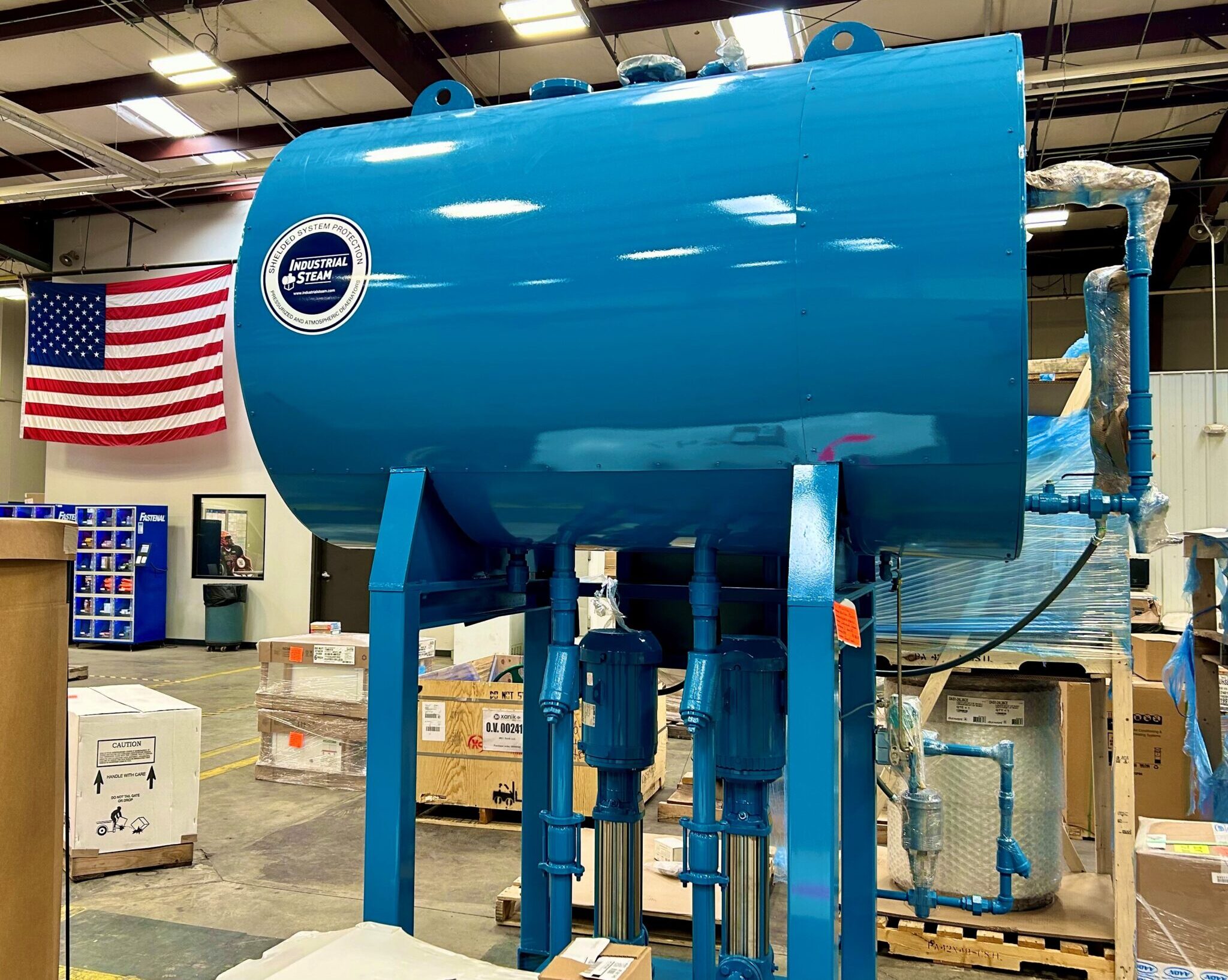
A deaerator (DA) strips dissolved oxygen and other gases out of boiler feedwater before they can corrode the boiler. Steam at about 5 psig scrubs incoming water from roughly 7 ppm dissolved oxygen down to about 7 parts per billion, while preheating feedwater to around 227°F, buffering condensate return swings, and controlling make-up water. An oxygen scavenger such as sulfite then handles the last traces — the DA and the chemistry work together, and both are required. Related reading: Deaerator 101
Can I use a feedwater tank instead of a deaerator?
Sometimes — on smaller or low-pressure systems (under about 15 psig steam), a hot water feed tank is a lower-cost alternative. But it must run at 180–190°F or hotter to drive off dissolved oxygen, and it needs a higher oxygen-scavenger feed than a true deaerator. If the tank runs cool, oxygen pitting in the boiler and feedwater piping usually follows. Related reading: Deaerator Maintenance: The Complete Guide
Does my boiler need a water softener or reverse osmosis?
A water softener removes calcium and magnesium hardness and is sufficient for many boilers, but it does not remove silica and typically requires 2–5% blowdown (20–50 cycles of concentration). Reverse osmosis removes about 98% of dissolved solids, cutting blowdown to roughly 0.5% (about 200 cycles) and slashing chemical use. RO costs more up front, but on low-makeup systems the savings in salt, chemicals, blowdown water, and fuel typically pay back in 2–5 years. Related reading: How Boiler Feedwater Quality Can Affect Boiler Operations
What chemicals are used in boiler water treatment?
Four functions cover most steam boilers: caustic for pH control and iron solubility (critical on RO water); an oxygen scavenger such as sulfite to react with residual dissolved oxygen; polymer to keep hardness in suspension so it leaves through blowdown instead of forming scale; and amine carried with the steam to neutralize CO2 so condensate doesn't turn acidic and corrode the return piping. Related reading: The Importance of Boiler Water Treatment
What is flash steam?
Flash steam forms when hot condensate at pressure drops to a lower pressure — through a steam trap orifice or a blowdown valve — and part of it instantly re-evaporates. Condensate at 100 psig (338°F saturation) flashes about 13.3% of its mass when reduced to atmospheric pressure. The resulting high-velocity steam/water mixture erodes valves and piping that weren't designed for it, and every pound of vented flash steam is wasted fuel and treated water. Related reading: Blowdown Separator: The Basics of Operation
How efficient is a condensing boiler?
Up to about 98%, depending on return water temperature. Condensing boilers are hydronic (hot water) only: they're built to condense water vapor out of the flue gas, recovering latent heat a conventional boiler sends up the stack. The lower the return water temperature, the more vapor condenses and the higher the efficiency — a system with hot return water won't reach the nameplate number. Related reading: Condensing Boiler Maintenance and Logs
Why are steam boilers dangerous if neglected?
A steam boiler is stored energy. Water in a boiler at 100 psig expands to roughly 200 times its volume instantly if the pressure envelope fails — ASME was founded in 1880 after a string of deadly boiler explosions and published the Boiler & Pressure Vessel Code in 1915 for exactly this reason. Modern safety devices and operator testing keep that energy contained; most incidents trace back to human error and skipped maintenance, not the equipment. Related reading: Low Water Boiler Conditions: Avoiding Boiler Catastrophes